Flat roof vs pitched roof: which is right for your Urbandale home
Flat or pitched? The answer depends on the building, the drainage, and the upkeep you are prepared for. Here is how the two roof forms compare for Urbandale homes in Iowa weather.
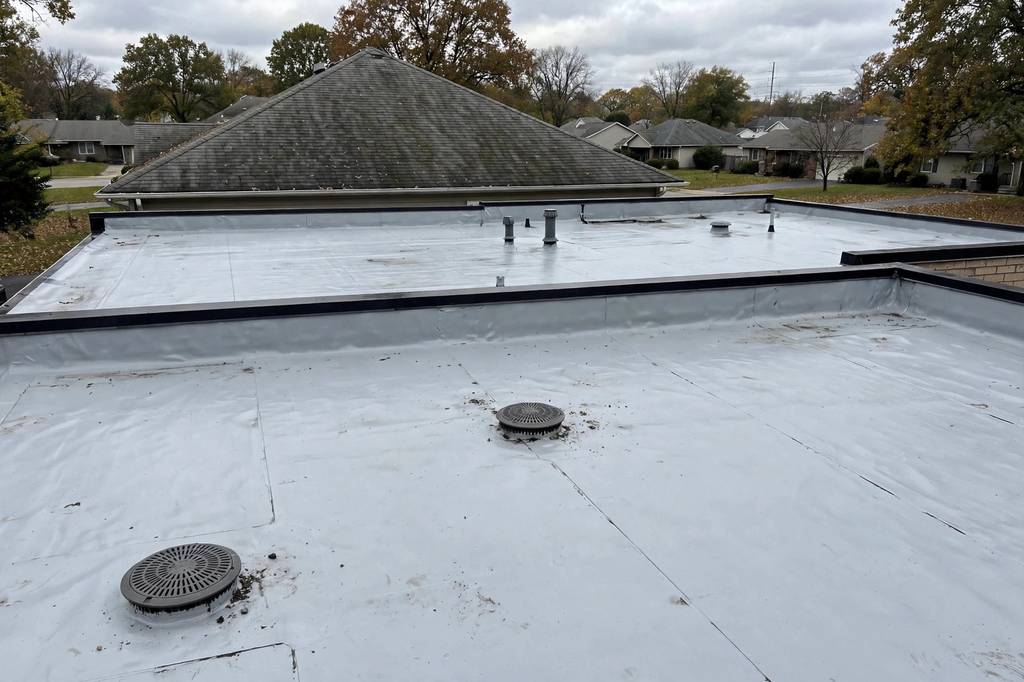
Flat roof vs pitched roof is usually decided by the building you already have. Most Urbandale homes carry pitched roofs, while flat and low-slope roofs appear on some homes, additions, garages, and commercial buildings. This guide compares the two forms on drainage, snow, hail, upkeep, and cost — and states plainly where no local figure exists.
A flat roof is not truly flat: it carries a slight slope toward drains or scuppers. A pitched roof sheds water by gravity down its slopes. That difference in how water leaves the roof drives most of the comparison that follows.
The short answer for Urbandale homeowners
For most Urbandale homes, a pitched roof is the practical default: it sheds water and snow by gravity, offers more material choices, and matches the surrounding housing. A flat or low-slope roof suits buildings designed for it — additions, garages, porches, and commercial structures — where the drainage system is planned from the start.
Neither form is immune to leaks by design. Pitched roofs leak at flashing, valleys, and penetrations; flat roofs leak at seams, drains, and ponding areas. The difference is where attention goes, not whether attention is needed.
If your home already has one form, changing to the other is a structural project, not a re-roof. The sections below explain what each form demands so the choice — or the upkeep plan — rests on facts.
How flat and pitched roofs actually differ
A pitched roof uses slope to move water: rain and meltwater run down the shingles or panels to the eaves, gutters, and downspouts. The covering overlaps in courses, so each row sheds onto the row below.
A flat or low-slope roof uses a continuous membrane — commonly TPO, EPDM, or modified bitumen — sealed at seams and drained through internal drains or scuppers. Water must be directed deliberately, because gravity alone does not clear it.
- Pitched: overlapping courses, gravity drainage, eaves and gutters.
- Low-slope: sealed membrane, planned drainage, drains and scuppers.
Urbandale's design criteria shape both forms: the City's adopted table lists a 30 psf ground snow load and 115 mph wind speed, and ice barrier protection is designated as required. Those figures describe design assumptions, not a promise about any individual roof.
Flat roof pros and cons Urbandale
Flat and low-slope roofs have genuine strengths and genuine demands. Weighing them honestly avoids the two common errors: assuming flat means simple, or assuming flat means trouble.
Pros
- Usable space above: roof-mounted equipment and access are simpler on a low-slope surface.
- Simpler geometry: fewer valleys and hips means fewer complex flashing details.
- Membrane continuity: a sealed membrane has no overlapping courses for wind to lift individually.
- Addition-friendly: tying a low-slope addition into an existing wall is often simpler than framing a new pitch.
Cons
- Drainage depends on upkeep: a blocked drain or scupper leaves standing water on the membrane.
- Ponding risk: any low spot holds water, and standing water stresses seams over time.
- Snow stays put: snow does not slide off a low-slope roof, so the structure carries the full load until it melts.
- Fewer material options: membrane systems suit low slopes; shingles do not.
For homes and buildings that already have a low-slope roof, flat roof repair in Urbandale covers membrane systems, drainage, and the details that keep standing water off the surface.
Pitched roof pros and cons in Iowa
Pitched roofs dominate Urbandale housing for practical reasons, but they carry their own demands — particularly at valleys, flashing, and penetrations.
Pros
- Gravity drainage: water and snow leave the roof without pumps or internal drains.
- Material choice: asphalt shingles, metal panels, and other coverings all suit pitched slopes.
- Ventilation path: a pitched roof naturally supports intake at the eaves and exhaust at the ridge.
- Repair in sections: damaged courses can often be repaired without disturbing the whole slope.
Cons
- Valleys and penetrations: every valley, chimney, vent, and skylight is a flashing detail that must stay sound.
- Wind exposure: individual shingle tabs can lift and crease in high wind.
- Access: steep pitches are harder and less safe to inspect and maintain.
When a pitched roof reaches the end of its service, roof replacement in Urbandale is the point at which slope, material, ventilation, and flashing are reconsidered together.
Flat roof vs pitched roof cost: what changes the comparison
No Des Moines-metro figure for flat or low-slope roofing was found in the sources reviewed for this site, and national figures are not re-labelled as local ones here. That gap matters: a flat-roof figure quoted without geography is not a reliable guide for an Urbandale project.
What can be said without inventing figures is which drivers move the comparison. For pitched roofs, the drivers are roof area, pitch, tear-off layers, decking condition, and the number of valleys and penetrations. For low-slope roofs, the drivers are membrane system, insulation and tapering, drainage work, and edge and penetration details.
A like-for-like comparison needs the same scope on both sides: tear-off, decking, underlayment or insulation, flashing, drainage, and ventilation. Figures that leave out tear-off or drainage are not comparable to figures that include them.
Ask for a written scope that separates each element before comparing any two figures. The site's cost guide explains how published market figures for roof replacement in Urbandale vary by source and basis, and why they should never be treated as a quote.
Which roof form handles snow and hail in Urbandale Iowa?
Snow behaves differently on the two forms. A pitched roof sheds snow as it melts and slides; a low-slope roof holds snow until it melts or is removed, so the structure carries the design snow load for longer. The City's 30 psf ground snow load is the design assumption behind both — it does not describe any single storm.
Hail strikes both forms. On pitched asphalt roofs it bruises shingles and strips granules; on low-slope membranes it can puncture or weaken the membrane at impact points. After any hail event, both forms deserve the same ground-level check for dents on metal, granule piles, and membrane marks.
The only Urbandale-named hail record found in the research for this site is 1-inch hail on March 14, 2025. Broader hail figures are metro-level only and are labelled as such wherever they appear. For storm-specific guidance, see hail damage roof repair in Urbandale.
Ice dams form on pitched roofs when attic heat melts snow that refreezes at the eaves; prevention runs through ventilation and insulation balance, covered under roof ventilation in Urbandale. Low-slope roofs face a different winter risk: drains blocked by ice hold meltwater on the membrane.
Can you put a pitched roof on a flat roof home Urbandale IA?
Putting a pitched roof over a flat-roofed home is possible in some cases, but it is a framing and structural project, not a re-cover. The existing structure must carry the new framing, covering, and snow load, and the junction with existing walls must be flashed as new work.
Whether a conversion is feasible for a given building depends on the structure, the existing roof system, drainage, and the scope of the change. No general answer covers every home, and no statement here should be read as permission or approval for a specific project.
- A structural assessment of what the existing walls and roof deck can carry.
- A drainage plan for the new slopes, including gutters, downspouts, and ground grading.
- A written scope covering framing, covering, flashing, ventilation, and removal of the old system.
Because the change alters the building's structure and drainage, it deserves professional assessment before any commitment. Ask what the assessment covers and get the scope in writing.
Common mistakes to avoid
The most common mistake is treating drainage as an afterthought on either form. On pitched roofs, gutters and downspouts that overflow dump water at the foundation; on low-slope roofs, blocked drains hold water on the membrane. Gutter installation in Urbandale and gutter upkeep belong in the same conversation as the roof itself.
- Assuming a flat roof needs no slope: every low-slope roof needs a planned path for water.
- Assuming a pitched roof cannot pond: valleys and dead spots behind chimneys can hold water.
- Comparing costs without matching scope: tear-off, insulation, and drainage must be on both sides.
- Ignoring ventilation on a pitched roof: a hot attic shortens shingle life and feeds ice dams.
- Walking a low-slope membrane carelessly: foot traffic and sharp debris can damage seams.
A roof inspection in Urbandale can show how the existing form is performing — where water goes, where it lingers, and which details need attention first.
When to call a professional
Call a roofing contractor when water is getting in, when drains or gutters overflow in ordinary rain, or when a conversion or major change is under consideration. Those are the points where a professional look saves repeat work.
Bring the building's history if you have it: prior leaks, prior repairs, and any drainage trouble. That history points the inspection at the details most likely to matter.
Rocc Solid Construction is a roofing contractor in Urbandale. Call (641) 219-5108 to talk about the roof form your building already has, or the change you are considering.
Frequently Asked Questions
Is a flat roof or pitched roof better in Urbandale IA?
It depends on the building. Pitched roofs suit most Urbandale homes and shed water by gravity; low-slope roofs suit buildings designed for them, with planned drainage. Neither form is without upkeep demands — the upkeep differs.
Why is there no single flat-roof figure for Urbandale?
No Des Moines-metro figure for flat or low-slope roofing was found in the sources reviewed, and national figures are not presented as local ones here. Any comparison needs a written scope covering membrane, insulation, drainage, and edge details.
Do flat roofs leak in Urbandale IA?
Any roof can leak. Flat roofs most often leak at seams, drains, and ponding areas; pitched roofs most often leak at flashing, valleys, and penetrations. Regular checks of the drainage path catch most trouble early.
Can you convert a flat roof to pitched in Urbandale Iowa?
Sometimes, as a structural project rather than a re-cover. It needs a structural assessment, a drainage plan, and a written scope. Feasibility depends on the individual building.
Which roof lasts longer in Iowa weather?
No single answer covers both forms. Service depends on the system, drainage, installation quality, and upkeep. A well-drained low-slope membrane and a well-vented pitched roof can both serve for a long time; a poorly drained example of either will not.
Get help with Roofing in Urbandale
If you are unsure which form suits your building — or whether the form you have is performing — call Rocc Solid Construction at (641) 219-5108. An inspection can show how water moves across the roof you have and what needs attention first.
Sources: City of Urbandale Municipal Code (adopted design criteria table).