How to tell if your roof has hail damage
Hail damage on an Urbandale roof shows up as bruised shingles, granule loss, and dented metal. Learn what to look for, how to document it, and when to call a roofer.
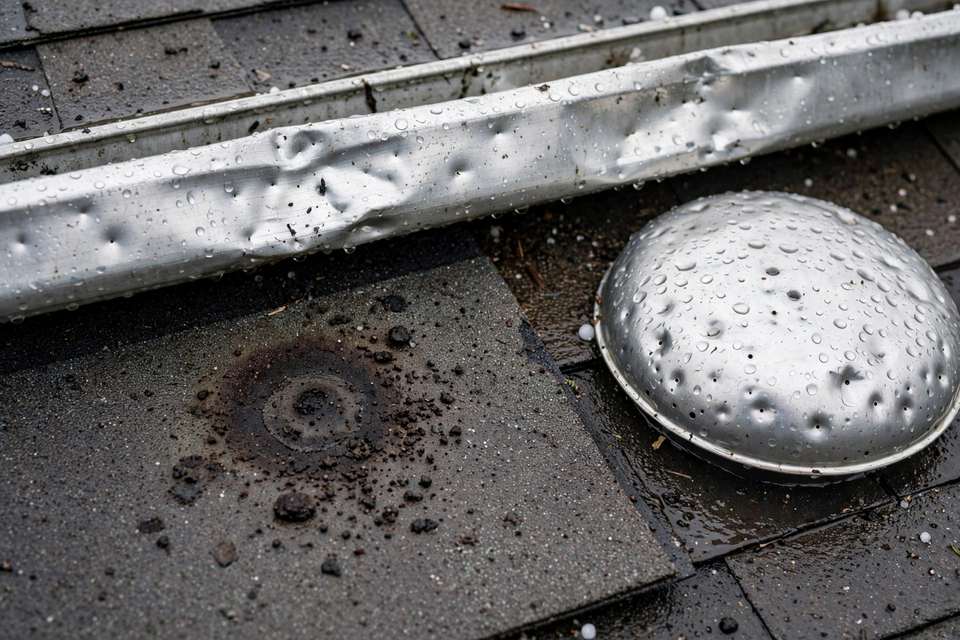
You can tell if your roof has hail damage by looking for bruised or soft spots on shingles, granule loss that exposes the mat, and dents on metal components like vents, flashing, and gutters. Those three marks together, found after a hailstorm, point to impact damage. This guide walks through what to check from the ground, what to check safely up close, how to photograph it for your insurer, and how repair and replacement decisions are weighed.
What hail damage actually looks like on a roof
Hail damage is a physical impact injury to the roof surface, not a stain or a color change. When a hailstone hits an asphalt shingle, it knocks off the protective granule layer and bruises the mat underneath. The spot looks dark, feels soft, and often has a ring of loose granules around it.
On metal, hail leaves round dents. On gutters and downspouts, dimples appear along the top edge and the face. On wood shake, hail cracks the shake face and splinters the grain. On tile and slate, hail chips corners and creates hairline cracks that are easy to miss from the ground.
Size matters, but no single size threshold decides whether damage occurred. Larger stones cause deeper bruising and mat fractures; smaller stones cause granule loss that accumulates over repeated storms. The check below looks for the marks themselves, not for a reported stone size.
How to tell if your roof has hail damage in Urbandale IA
How to tell if your roof has hail damage comes down to a systematic check of five zones: shingle fields, ridge caps, metal vents, flashing, and gutters. Do the ground-level check first, then decide whether an up-close look is safe.
Start from the ground
- Walk the perimeter and look at downspouts and gutter faces for dents and dimples.
- Check window screens, air-conditioner fins, and mailbox tops for impact marks — hail hits those at the same angle it hits the roof.
- Look for granules piled at the base of downspouts, which signals shingle surface loss.
- Scan the roof plane from a distance for dark patches or shiny spots where the mat is exposed.
If the ground check turns up dents on metal, the shingles likely took a hit too. A roof inspection in Urbandale can walk the roof where safe, photograph every impact zone, and produce a written report for the homeowner's records.
What to check up close (only if you can do it safely)
From a ladder at the eave, look at the shingle tabs on the slopes that faced the storm. Hail bruises show as soft, dark circles. Press gently — sound shingle feels firm, bruised shingle feels spongy. Never walk a steep or wet roof, and never work alone on a ladder.
Signs of hail damage on asphalt shingles Urbandale Iowa
Signs of hail damage on asphalt shingles fall into four categories. Finding two or more together strengthens the case that hail, rather than age, caused the marks.
- Bruises: soft, dark circular spots where granules are gone and the mat is crushed.
- Granule loss: bare patches, shiny areas, or granules collecting in gutters and at downspout outlets.
- Fractures: cracks in the shingle mat, usually on older shingles that have lost flexibility.
- Lifted or torn tabs: shingles peeled back by wind that often accompanies hail.
Three-tab shingles show damage more obviously than architectural shingles because the mat is thinner. Architectural shingles hide bruises better, which is why an up-close look matters. See asphalt shingle roofing in Urbandale for how shingle systems differ.
Hail damage vs. normal wear: how to tell the difference
Hail damage is sudden and concentrated on the slopes that faced the storm; normal wear is gradual and spread more evenly across the roof. That distinction matters for every insurance decision, so it is worth slowing down on.
Normal aging shows as uniform granule loss, curling shingle edges, and a roof that looks tired everywhere. Hail damage clusters on storm-facing slopes and leaves sheltered slopes looking comparatively sound. If one side of the roof is marked up and the other is not, that pattern points to impact, not age.
Other look-alikes to rule out: blistering from attic heat (round blisters with a popped top, no impact ring), foot-traffic scuffing, and manufacturing variation (straight-line patterns). A roof repair in Urbandale visit can separate those causes, which matters because storm damage and wear are treated differently.
How to document hail damage for insurance Urbandale IA
Documentation for your insurer starts the day of the storm, not the day an adjuster arrives. Granules wash away, shingles seal down, and dents get overlooked as weeks pass. This page is general information, not legal or insurance advice — check your policy, your agent, or your carrier for what your coverage requires and when.
- Photograph every dented gutter, downspout, vent, and piece of flashing with a tape measure or coin for scale.
- Photograph the shingle damage from a ladder at the eave, one wide photo and one close-up per slope.
- Save the storm date, time, and any hail size reports from local news or the National Weather Service.
- Keep a written log of when the damage was noticed and who inspected it.
- Do not throw away damaged materials — they may be needed for the inspection.
A photo report and a written scope support the homeowner's own claim process. Hail damage roof repair in Urbandale covers the repair side of hail events.
Does hail damage roof require replacement Urbandale Iowa?
Hail damage does not always mean replacement. Small bruised areas on a younger roof can sometimes be repaired; widespread bruising, mat fractures, or damage on a roof already near the end of its service more often points toward replacement. No percentage threshold is stated here: the decision follows the extent of damage, the roof's age and condition, and the written scope.
Repair makes sense when damage is isolated to one slope, the shingles are still flexible, and the rest of the roof is sound. Replacement makes sense when bruises are scattered across multiple slopes, granules are gone in sheets, or the roof is already near the end of its service. Putting new shingles over a bruised deck moves the problem forward rather than solving it.
If replacement is the answer, the options include architectural shingles, impact-rated Class 4 shingles, and metal. No discount or premium figure is published here for Class 4 shingles — check with your insurer. See roof replacement in Urbandale for how replacement scope is set out.
Common mistakes when checking for hail damage
The biggest mistake is checking the roof from the ground and calling it good. Hail bruises on architectural shingles are nearly invisible from twenty feet away, and the damage that matters most — fractured mat and soft spots — only shows up close.
Other mistakes seen every storm season:
- Walking the roof in sneakers on a wet or steep pitch.
- Signing with a door-to-door crew before verifying Iowa DIAL registration.
- Making repairs before photographing the damage.
- Accepting an offer to absorb the amount a policy leaves the homeowner to pay — Iowa law bans that practice.
- Assuming a newer roof cannot be hail-damaged. It can. Impact-rated shingles reduce damage but do not eliminate it.
One more: waiting. Granules loosen and wash off within a few heavy rains, and the visible evidence fades with them — while the bruised mat stays bruised.
When to call a professional
Call a roofer when you find dents on metal, granules in the gutters, or any soft spot on a shingle — those three together usually mean a legitimate storm claim deserves a look. Call sooner if daylight shows through the deck, water stains appear on the ceiling, or shingles are missing after the storm.
Rocc Solid Construction is a roofing contractor in Urbandale. The services page lists the roofing work available. For context on local hail: the only Urbandale-named hail record found in the research for this site is 1-inch hail on March 14, 2025. Broader figures are metro-level only — 100 hail days within 15 miles of Des Moines since 2010, with the largest at 3.25 inches on July 9, 2021, in Beaverdale — and different radii and periods give different largest values, so metro figures are never presented as Urbandale figures.
Frequently Asked Questions
How can I tell if my roof has hail damage in Urbandale IA?
Look for dents on gutters, downspouts, and vents, granules piled at downspout outlets, and soft dark spots on shingles. If you find those after a hailstorm, arrange an inspection before the evidence washes away.
What does hail damage look like on a roof in Urbandale Iowa?
On asphalt shingles: dark, soft circular bruises with a ring of loose granules. On metal: round dents. On wood shake: cracked or splintered faces. Damage concentrates on the slopes that faced the storm.
Will insurance cover hail damage to my roof?
That depends on the individual policy, the cause of the damage, and the roof's prior condition — no coverage promise is made here. Dated photographs and a written inspection report support the homeowner's own claim process. Check your policy, agent, or carrier.
What should I do first after a hailstorm?
Check from the ground, photograph dents, granule piles, and soft spots, save the storm date and any weather reports, and arrange an inspection before repairs change the scene. No filing deadline is stated here — check your policy, agent, or carrier.
Can hail damage be repaired without replacing the whole roof?
Sometimes. Isolated damage on one slope of a younger, flexible roof can be repaired. Widespread bruising, mat fractures, or damage on a roof near the end of its service more often points toward replacement. No percentage threshold is stated here.
Get help with Roofing in Urbandale
If a storm rolled through and you are not sure what you are looking at, an inspection can photograph what is there and set out plainly whether it is a repair, a replacement, or nothing to worry about.
Call Rocc Solid Construction at (641) 219-5108 to arrange a hail damage inspection in Urbandale.
Sources: Iowa Insurance Division — hail claims guidance; Iowa Department of Inspections, Appeals, and Licensing (DIAL) — contractor registration.